When you buy a supplement, do you normally check the label?
Vitamin C — 500 mg.
Calcium — 500 mg.
Herbal extract — 200 mg.
Most of us assume that whatever is written on the bottle is exactly what is inside.
But here is the uncomfortable truth:
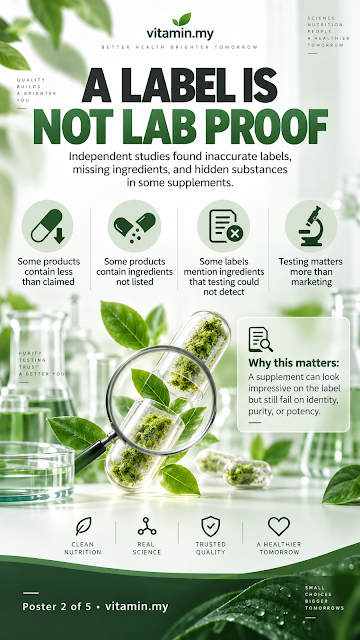
A LABEL IS NOT LAB PROOF.
Independent studies have found that some supplements may contain ingredients in amounts different from what is stated on the label. Some products have contained undeclared substances, while other listed ingredients could not even be detected during laboratory testing.
This does NOT mean every supplement is poor quality.
It means supplement quality can vary — sometimes significantly.
So what should “quality” actually mean?
✅ IDENTITY
Is it really the correct ingredient or botanical species?
✅ PURITY
Has it been checked for unwanted substances?
✅ POTENCY
Does it contain approximately the amount stated on the label?
✅ SAFETY
Has it been screened for microbes, pesticides and heavy metals?
✅ STABILITY
Will it maintain acceptable quality until the expiry date?
This is where laboratory testing becomes important.
Shaklee states that its quality programme includes more than 100,000 quality tests across its product portfolio every year.
For new botanical ingredients, Shaklee also reports screening for more than 350 potential contaminants.
According to the company, raw materials undergo an average of 19 quality checks before being approved for manufacturing, followed by additional checks on finished products before release.
What can be tested?
🔬 Ingredient identity
🔬 Potency
🔬 Microbiology
🔬 Heavy metals such as lead, arsenic, mercury and cadmium
🔬 Pesticide residues
🔬 Physical tablet quality
🔬 Stability over shelf life
Why is this important?
Because “natural” does not automatically mean contaminant-free.
Plants grow in soil.
Soil naturally contains minerals and metals.
Agricultural crops can be exposed to pesticides.
Microorganisms exist naturally in the environment.
Even organic ingredients still need proper verification.
And remember:
GMP does NOT simply mean a clean-looking factory.
Good Manufacturing Practice covers processes such as employee training, equipment calibration, sanitation, raw-material specifications, batch records, cross-contamination control, traceability, packaging and quality review.
But there is another important distinction.
QUALITY ≠ PROOF OF CLINICAL EFFECTIVENESS.
A supplement may be manufactured perfectly and contain exactly what the label claims.
That tells us:
“Is this product what it claims to be?”
Clinical research asks another question:
“Does this ingredient actually produce meaningful health benefits in humans?”
These are two different scientific questions.
So before buying any supplement, ask:
✔️ Who manufactures it?
✔️ Is there GMP or regulatory compliance?
✔️ Are raw materials tested?
✔️ Is the finished product tested?
✔️ Are contaminants screened?
✔️ Is potency checked?
✔️ Is there stability testing?
✔️ Are the health claims realistic?
Do not compare supplements by milligrams and price alone.
RM40 for 500 mg versus RM100 for 500 mg does not automatically tell you which one is better.
Behind those milligrams may be completely different systems of sourcing, testing, quality control, laboratories, traceability and manufacturing standards.
The bottle is only the final stage.
Behind a genuinely high-quality supplement should be:
Farms.
Suppliers.
Specifications.
Scientists.
Laboratories.
Testing.
Manufacturing controls.
Documentation.
Traceability.
Verification.
You are not just buying a label.
You are buying a QUALITY SYSTEM. 🌿🔬
Better choices start with better questions.
Read more at vitamin.my
#vitaminmy #Shaklee #ShakleeMalaysia #SupplementQuality #Vitamins #HealthSupplements #Nutrition #HealthyLifestyle #SupplementFacts #GMP #QualityControl #HealthEducation #Wellness #NutritionScience
.png)
.png)
.png)
.png)
.png)
